JNBridgePro · Engineering automation
Automate Siemens TIA Portal from Java.
Your application is Java. Siemens’ engineering API is .NET. JNBridgePro connects them so your existing Java application can create controllers, configure PLC tags, and inspect TIA projects.
Keep your equipment data and engineering logic in Java, without building a separate C# integration application around these operations.
Demonstrated with TIA Portal V21. Offline project generation; no physical PLC required.
Input · Java application
Assembly station definition- Controller
- CPU 1511-1 PN
- PartPresent
- Bool · %M0.0
- RecipeNumber
- Int · %MW2

Two sample input signals; actual TIA result from the five-tag demo.
Why use JNBridgePro?
Use the Java application you already have.
A machine configurator may already know the controller and signals a station needs. JNBridgePro lets it use that information to create the corresponding Siemens project objects.
Keep engineering decisions in Java
Your existing code supplies the equipment data and selection rules. It can drive Siemens engineering operations from the same application.
Use Siemens objects directly
JNBridgePro-generated proxies let Java call the project, device, and tag objects used in this example. No custom C# service is needed around those calls.
Hand engineers a real project
The output opens in TIA Portal, where a controls engineer can inspect the configuration and continue developing it.
How it connects
JNBridgePro bridges the Java/.NET boundary.
Generate Java proxies from Siemens’ .NET assemblies, then call them from your application. JNBridgePro handles the connection; Siemens Openness performs the engineering operations.
Demonstrated architecture · one Windows engineering workstation
Java application process
Separate Siemens process
Java supplies the configuration. Siemens Openness performs the engineering operations. The output is a saved .ap21 project that can be opened in TIA Portal.
This shared-memory demonstration runs on one Windows workstation. TIA Portal remains its own engineering process.
Engineering software meets production equipment
Why this boundary matters in advanced manufacturing
SpaceX’s public Starship Design Software role includes connecting electronics design software with manufacturing equipment and lists C#.NET or Java among preferred programming experience. Its Starship Automation & Controls role covers production-line automation, lists C#/.NET experience, and prefers PLC programming experience with Siemens TIA Portal and Beckhoff TwinCAT 3.
The architectural inference: a manufacturer with higher-level engineering software and Siemens-controlled equipment could need to turn application data into TIA project configuration. If the application is written in Java, that workflow can encounter the Java/.NET boundary demonstrated here. The postings do not establish that SpaceX uses Java for that system or has a Java-to-TIA integration.
Public job descriptions reviewed September 15, 2026.
The demonstrated result
Created in Java.
Opened in TIA.
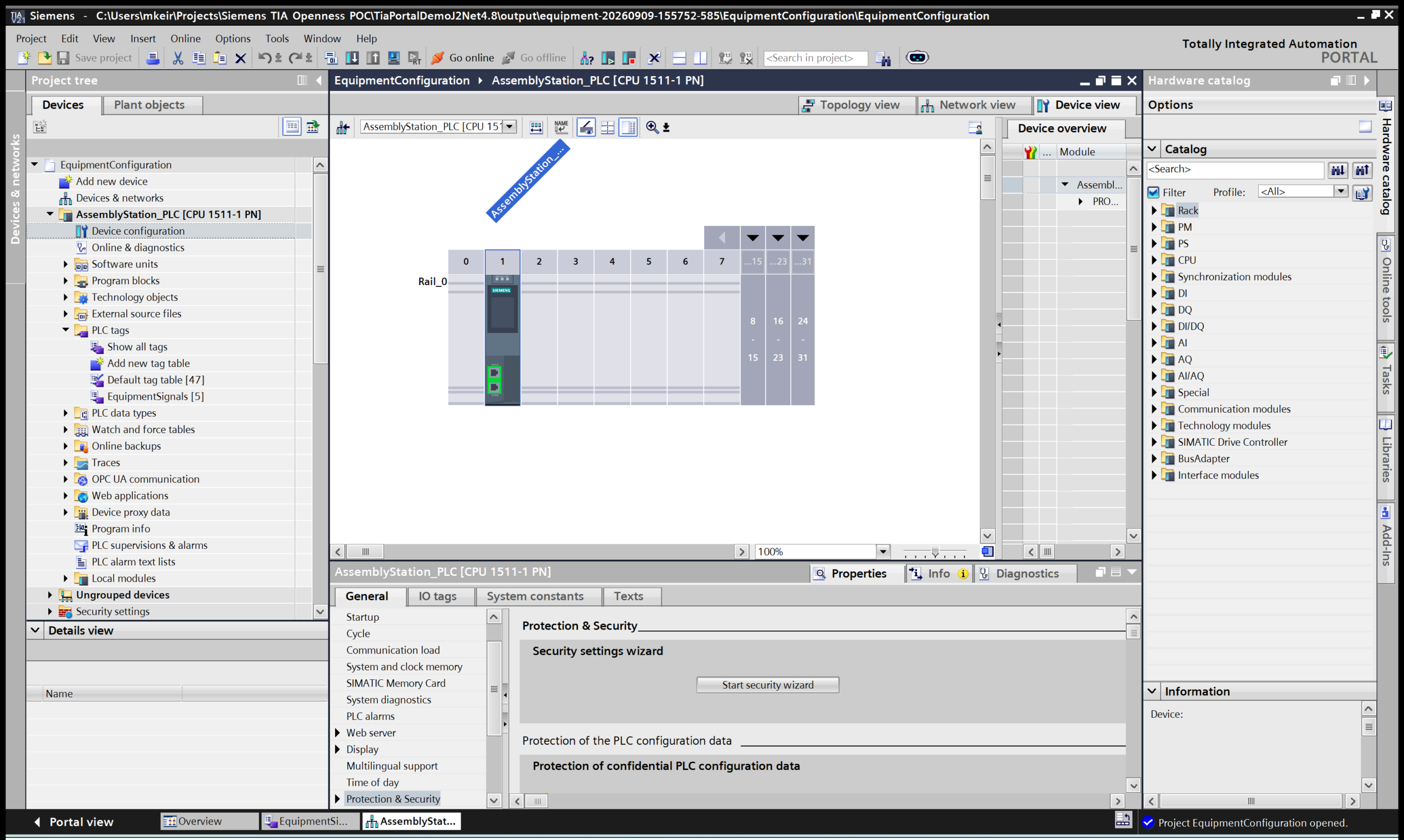
The example generated an AssemblyStation controller and an EquipmentSignals tag table. Java then reopened the saved project and compared the configured tags with the original input.
- Exact controller checked against the installed catalog
- Five tags created with specified types and addresses
- Saved configuration verified after reopening
- Independent inspection in a fresh Java/TIA session
Questions about this integration
Where does it fit?
When is this useful for a Java application?
When Java owns equipment configuration or engineering decisions and needs to inspect or create TIA project objects as part of that workflow. A static tag-list import may be enough for a simpler one-time exchange; the bridge is useful when the application needs direct interaction with Siemens objects.
Do I need a physical PLC to explore the example?
The demonstrated workflow creates offline engineering configuration using an installed TIA Portal environment. It needs the appropriate Siemens software, licensing, and Openness access, but did not require a physical PLC or simulator.
What did the demonstration verify?
Project creation, catalog selection, CPU and tag-table creation, and saved-data readback. It demonstrates this engineering workflow; it does not establish PLC program execution or complete Openness API coverage.
How would this connect to our own engineering software?
The demo reads a small equipment definition in Java. An existing application could supply its equipment objects at that same point, apply its own validation, and use the bridge to carry out the relevant Siemens operations. Talk with us about the operations your application needs.
Connect your Java application to Siemens engineering.
Tell us what your application needs to create or inspect in TIA Portal.